

tagesschau’s biased headlines and summaries: ‘Palestine’ omitted, ‘terrorist’ emphasized
tagesschau keyword analysis report, part 1
Welcome to the first post in our data analysis series. We plan to publish further chapters that expose systemic biases in German media. Stay tuned for more, and we’d love to hear your thoughts!

Summary
tagesschau is one of Germany’s largest news services, with millions of viewers every day. It is a public broadcaster, tasked by law with informing the German public in a balanced way, and is considered the “most trusted media source” for German citizens. However, like many other German mainstream media outlets, its coverage of Palestine has been problematic, containing biases and presenting a one-sided perspective. For instance, between October 2023 and September 2025, de:presse documented 94 tagesschau news articles due to heavily biased coverage of Palestine in its archive. This is just the tip of the iceberg, as the recorded cases are only the notable ones, and it’s likely the total number of biased articles far exceeds this amount.
Next to TV news and online segments such as articles, audio and video pieces, tagesschau also offers news updates through Telegram and WhatsApp channels that are almost identical in content, sending selected news in bullet points twice a day, with the latter subscription base now exceeding 2.6 million users. Since tagesschau produces a large amount of news articles, it’s crucial to check for systematic bias not only on article level but also across aggregated headlines and in article summaries, as this significantly affects public opinions in German society.
In this research, we collected 25,592 headlines and summaries from the tagesschau website’s RSS feed that contains all titles and summaries of news articles published on the website tagesschau.de and its official Telegram/WhatsApp feeds between October 1, 2023 and September 15, 2025.1 By keyword matching, we found 2,912 news items about Palestine-Israel and 2,949 about Ukraine-Russia. Strikingly, we found that the words “Palestine/Palestinians” are mentioned five times less frequently than “Israel/Israelis,” whereas “Ukraine/Ukrainians” and “Russia/Russians” are mentioned with approximately equal frequency. Another finding is that the term “terrorist” is often associated with Palestine-Israel, and this tendency is far more pronounced (three times more) on its Telegram/WhatsApp channels.
The outlet should be held accountable for this reporting bias and correct it. Our findings show that tagesschau clearly sidelines Palestine and spotlights Israel. It repeatedly associates Palestinians with the term “terrorism” while excessively citing Israeli government sources, as Fabian Goldmann has also shown in his extensive research on the tagesschau. Whether intentional or not, this reporting serves to shield Israel which has been committing acts internationally recognized as genocide and war crimes. More than 60,000 people have been killed in Gaza – mostly civilians – and a third of the victims are children. Prime Minister Netanyahu has already been charged as a war criminal by the International Criminal Court (ICC).
Omitting these facts does not constitute neutral reporting. Instead, it legitimizes Israel’s criminal actions and misinforms the public, which is illegal under the German Grundgesetz (Basic Law).
Key findings
The word “Palestine/Palestinians” is mentioned far less frequently than “Israel/Israelis” (five times less)
“Palestine/Palestinians” is mentioned infrequently (18%), while “Israel/Israelis” is mentioned very frequently (85%) in the topic Palestine-Israel which was defined as a combination of “Palestine/Palestinians” and “Israel/Israelis” keyword matches.2 This contrasts with the topic Ukraine-Russia, where “Ukraine/Ukrainians” (75%) and “Russia/Russians” (69%) are mentioned more equally. This tendency to avoid naming the Palestinian identity distorts the narrative, consistently spotlighting Israel while marginalizing Palestinians. In this, there is no difference between website and Telegram/WhatsApp sources; the same tendency appears throughout.
The term “terrorist” is disproportionately emphasized in the topic of Palestine-Israel compared to other topics (more than ten times).
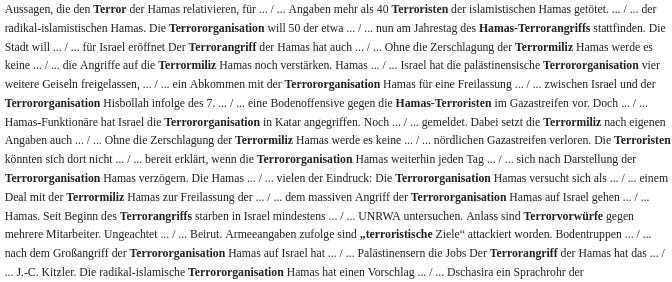
The term “terrorist” is mentioned far more often (11%-32%) in the topic Palestine-Israel, compared to the topic Ukraine-Russia (1-2%) or any other topics (1-3%). Most of these mentions concern Hamas, such as “die Terrororganisation Hamas”, with only a small number referencing Hezbollah. This frequency is significantly higher than that of keywords like “killed” (10-14%), “humanitarian” (4-8%) and “genocide (1%) for the topic Palestine-Israel. Consequently, tagesschau consistently frames Palestine through the association of “terrorism”, contributing to a narrative that can be used to justify the acts of genocide by Israel.
The emphasis on the term “terrorist” is significantly more prevalent on Telegram/WhatsApp than on the official website (three times more).
The keyword “terrorist” is disproportionately mentioned on the Telegram/WhatsApp (32%) compared to headlines and summaries on the website (11%). The Telegram bot was shut down in August 2025, but the WhatsApp channel that has near-identical content is still operating. One hypothesis to explain this excessive mention of “terrorism” is that the concept is favoured because of its sensational nature, which boosts attention and interaction from users. This is particularly concerning given that the WhatsApp subscriptions now exceed 2.6 million users and the short news items posted here affect a large number of readers whose only regular source of news might well be these short summaries.
It’s also noteworthy that on both the website and Telegram/WhatsApp, the keywords “hostage” and “ceasefire” rank higher than “killed”. Furthermore, keywords describing rights crises and violations, such as “humanitarian,” “refugee,” “victims,” and “famine,” are mentioned even less. This illustrates how tagesschau frames the topic as a “nightmarish scenario of the poor hostages,” emphasizing the promise of a “ceasefire” that, in reality, doesn’t materialize for Palestinians in Gaza, getting violated on a daily basis by Israel even when the so-called “ceasefire” is officially in place.
Reporting in breach of rights
Our research has only just started on a very narrow selection of topics, but it is very clear from the above findings that readers are not getting informed properly by the tagesschau. Under Germany’s Medienstaatsvertrag, broadcasters are legally obliged to verify, provide balanced information, and protect human dignity.
Failing to question military narratives such as “all Palestinians are terrorists” normalizes attacks on civilian targets, weakens public understanding of war crimes and erodes trust in public broadcasting. Trivializing war crimes by omission (not mentioning the victims, in this case) is not journalism – it is complicity.
Our findings thus indicate that the reporting of the outlet is in breach of German legislature. We must demand accountability from tagesschau.
Our demands to tagesschau
Accountability and editorial transparency
Explain the editorial policies that guide your reporting on Palestine-Israel and the origins of aforementioned biases. Establish standards to follow to ensure impartiality and balance.
Do not sideline Palestine and Palestinians
Refer to Palestine and Palestinians as an equally valid political and ethnic entity alongside Israel and Israelis, just as any other nation‑state or comparable group.
Stop marking Palestinians as “terrorists”
Excessive association of “terrorism”-related terms with Palestinians is deeply biased and cannot be justified. Israel’s war crimes and international law violations are nothing but state terrorism and must be reported as such.
Clarity regarding bias on Telegram/WhatsApp feeds
Explain the root causes of stronger bias in Telegram/WhatsApp channel feeds. Do you intentionally use the term “terrorist” frequently to gain more attention? For a public broadcaster to follow such a strategy goes against its duty to inform readers in a balanced manner and enforces racist stereotypes, especially against the people experiencing ongoing genocide.
We will submit our report and our demands to the tagesschau regulatory board with the ARD. In the meantime, keep complaining about biased reporting!
Methods
Data collection
Website RSS (October 2023 – September 2025): Based on an unofficial Telegram RSS feeds channel whose content is identical to the official website RSS data.
Telegram bot (October 2023 – August 2025): An official bot that operated until August 2025. The format and writing style differed from the official website.
WhatsApp channel (August 2025 – Sepember 2025): An official channel launched in October 2023, using a mostly similar format to the Telegram bot.
Preprocessing
Removal of irrelevant text
Telegram/WhatsApp channel data contain frequent greetings, polls and info paragraphs. They are detected based on keyword matching and then discarded.
Decomposition to news items
If a post has multiple news items, they are counted separately.
Outcome
The number of data points are 21,007 (Website RSS), 4,260 (Telegram bot), and 325 (WhatsApp channel).
Analysis
Keyword match
Keyword matching is performed against the combined headline (title) and summary text. For each keyword, multiple terms are considered. For instance, the “Palestine” keyword is matched against any of “Palästina, Palästinenser, palästinensisch”.
Topic definition
We defined three topics: “Palestine-Israel”, a combination of “Palestine,” “Gaza,” “West Bank,” and “Israel” keywords (2,912 data points); “Ukraine-Russia”, a combination of “Ukraine” and “Russia” keywords (2,949 data points); and “Other” (19,731 data points).
Source type grouping
We combined Telegram bot and WhatsApp channel as one condition and compared it against ‘Website’ (RSS feed) condition. Both Telegram/WhatsApp and Website source type covered the same period.
The research was conducted with the original texts in German and with German language keywords.
“Gaza” is mentioned relatively often (47%) compared to “Palestine/Palestinians”, but still the frequency is far less than “Israel/Israelis”.